Read a vote: the result, the party split and every member's answer
On this page
A vote's page shows one roll call from start to finish: what the members were asked to decide, the result, how each party voted, which members went against most of their own party, and the answer of every member, with a link to the official record.
Open a vote from the Votes page, from a bill's Roll-call votes card, from a member's Votes card, or from the overview.
#The top of the page
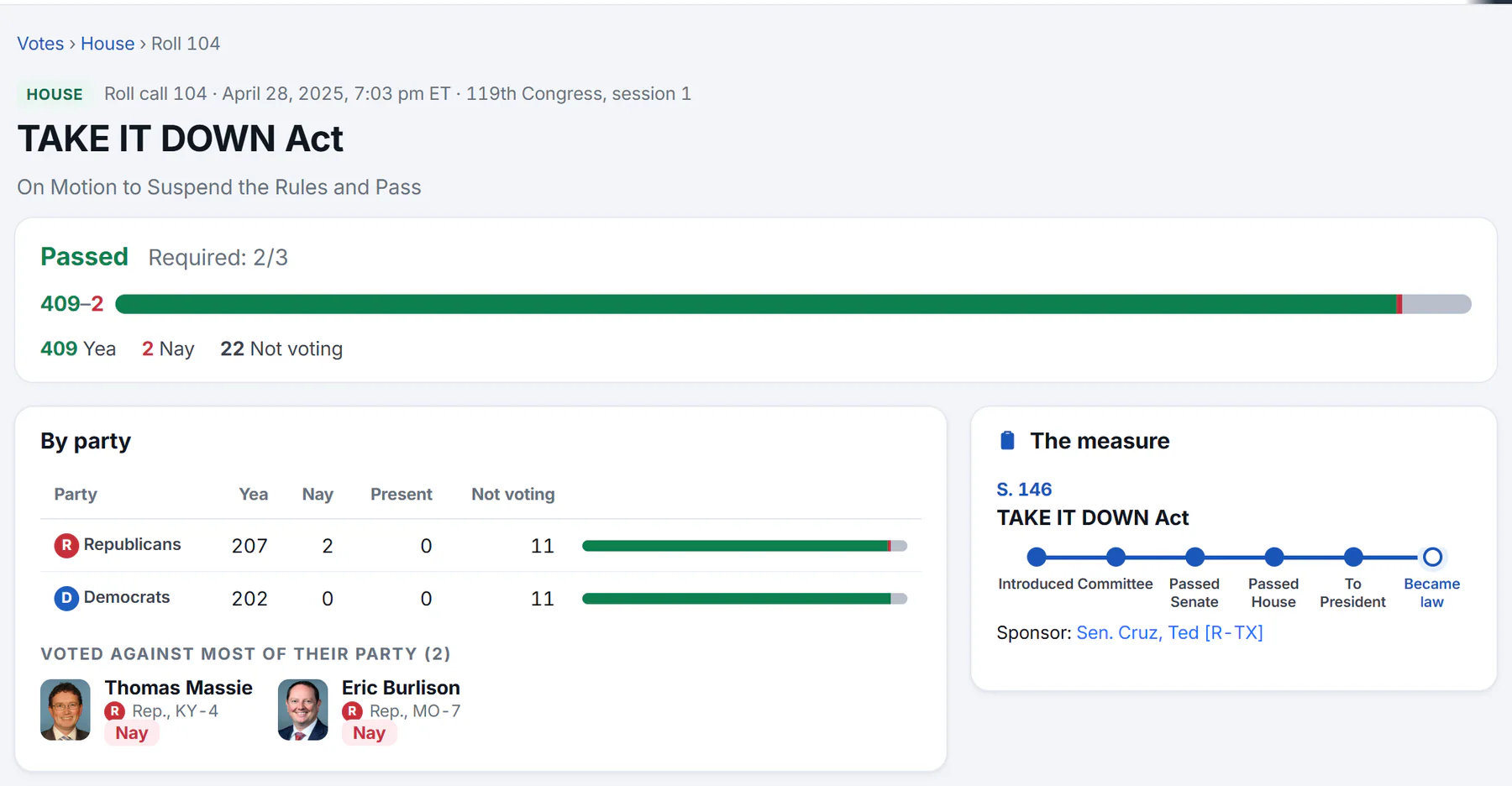
The top of a vote page: the question, the result with the majority required, the tally, the party split, and the bill the vote was on.
- 1Chamber, roll number, date and time
- 2The result and the majority needed
- 3Yeas and nays at a glance
- 4How each party voted
- 5Members who voted against most of their party
- 6The bill that was voted on, and where it stands
- The first line gives the chamber, the roll call number, the date and, when the source records it, the time in Eastern time, and which Congress and session the vote belongs to.
- The headline is what the vote was about, usually the bill's title. The line below it is the exact question put to the members.
- The result is the House Clerk's or the Senate's wording, such as Passed or Rejected, followed by Required: the share of votes needed, for example 1/2 (simple majority), 3/5 or 2/3. The majority comes from the official record of that vote.
- The tally is a bar and the counts of Yea, Nay, Present and Not voting. Present appears only when someone answered that way.
Below that, the By party table gives each party's yeas, nays, present and not voting, with a bar. Under it, Voted against most of their party lists the members whose answer was opposite to the way most of their party voted, with a photo and how they voted. Select a name to open the member's page.
The side column has The measure, with the bill's number, its title, its progress tracker and its sponsor, so you can see what became of it. A vote on a nomination shows the nomination's number and says it is a nomination. When the measure has other votes, Other votes on this measure lists them.
An AI Briefing may sit between the result and the tables.
#How every member voted
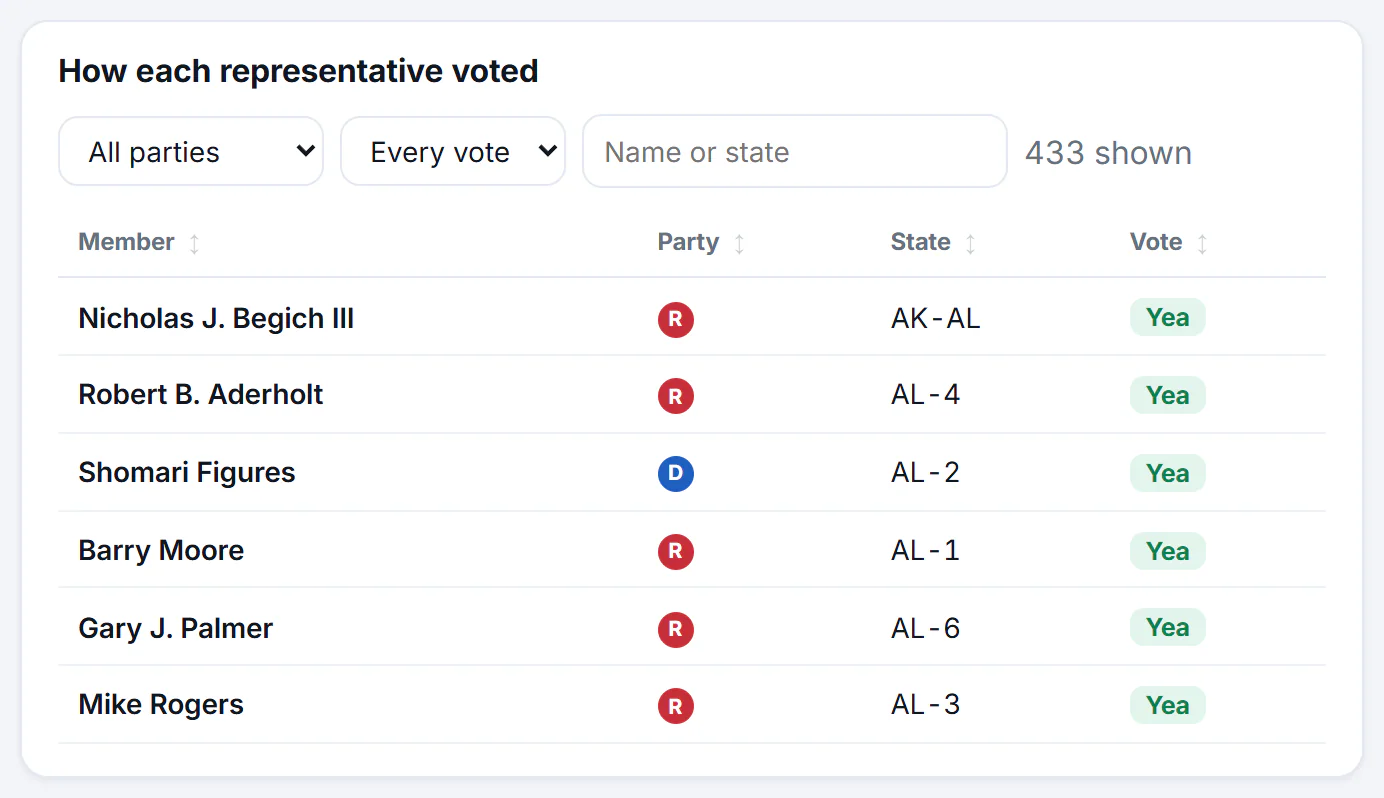
Every member's answer. The menus and the box narrow the list; the headings sort it.
- 1Filter by party
- 2Filter by how they voted
- 3Find a member or a state
- 4Select a heading to sort
- 5Yea, Nay, Present or Not voting
The How each representative voted card (How each senator voted for the Senate) lists every member with their party, state or district and answer. On a page with JavaScript you can:
- choose a party in the first menu, All parties by default;
- choose an answer in the second menu, Every vote by default, to see only Yea, Nay, Present or Not voting;
- type a name or a state in the box, and watch the count of rows shown change;
- select a heading to sort, and select it again to reverse the order.
To find your own representative or senator quickly, type their name or your state's name or abbreviation.
#Yea, Nay, Present and Not voting
| Answer | What it means |
|---|---|
| Yea | The member voted in favor. |
| Nay | The member voted against. |
| Present | The member was there and chose to vote neither yea nor nay. |
| Not voting | The member did not cast a vote. The record does not say why. |
A member whose answer is Yea or Nay and who differs from most of their party gets an against party tag in lists of that member's votes.
#What the question line means
The question line uses the wording of the House Clerk and the Senate. These are the ones you will meet most.
| The question says | What is being decided |
|---|---|
| On Passage | Whether the chamber passes the bill. This is the chamber's final vote on it. |
| On Motion to Suspend the Rules and Pass | A House shortcut for passing a bill after limited debate. It needs two-thirds, so the page shows Required: 2/3. |
| On the Cloture Motion or On Cloture on the Motion to Proceed | A Senate vote to end debate so that a vote can take place. The majority needed is shown on the page. |
| On the Motion to Proceed | Whether to begin considering a measure. |
| On the Amendment | Whether to adopt a proposed change to a bill. |
| On the Nomination | Whether to confirm someone the President has nominated. |
| On Motion to Recommit | A House motion to send a bill back to committee. |
| On the Motion to Discharge | A motion to take a measure out of a committee's hands. |
#Common questions
What does "Required: 3/5" mean?
It is the share of the votes needed for the question to succeed. For most questions it is a simple majority, shown as 1/2 (simple majority). Some need more: 2/3 for a House vote to suspend the rules, and 3/5 for a Senate vote to end debate on a bill, as the record states.
Why do I see "against party" next to a name?
That member voted Yea or Nay the opposite way from most of their own party on this roll call. It says how their vote compared with their party's, not why they voted as they did.
Why can I not open a senator's name?
A few names on a Senate roll call cannot be matched to a member record. Their answer is still counted, but the name is not a link.
How does Politics decide who "most of their party" is?
It looks at the Yea and Nay answers of each party on that roll call and takes the side with more votes. An independent is compared with the party they caucus with.
Where does the vote come from?
From the House Clerk for House votes and the U.S. Senate for Senate votes. The Source card on the page links to that record.